
Your Degree Is Expiring: Which Jobs and Educations Won't Survive AI
2026-03-13 · 7 min read

AI / Future
Your Degree Is Expiring: Which Jobs and Educations Won't Survive AI
Your Degree Is Expiring: Which Jobs and Educations Won't Survive AI

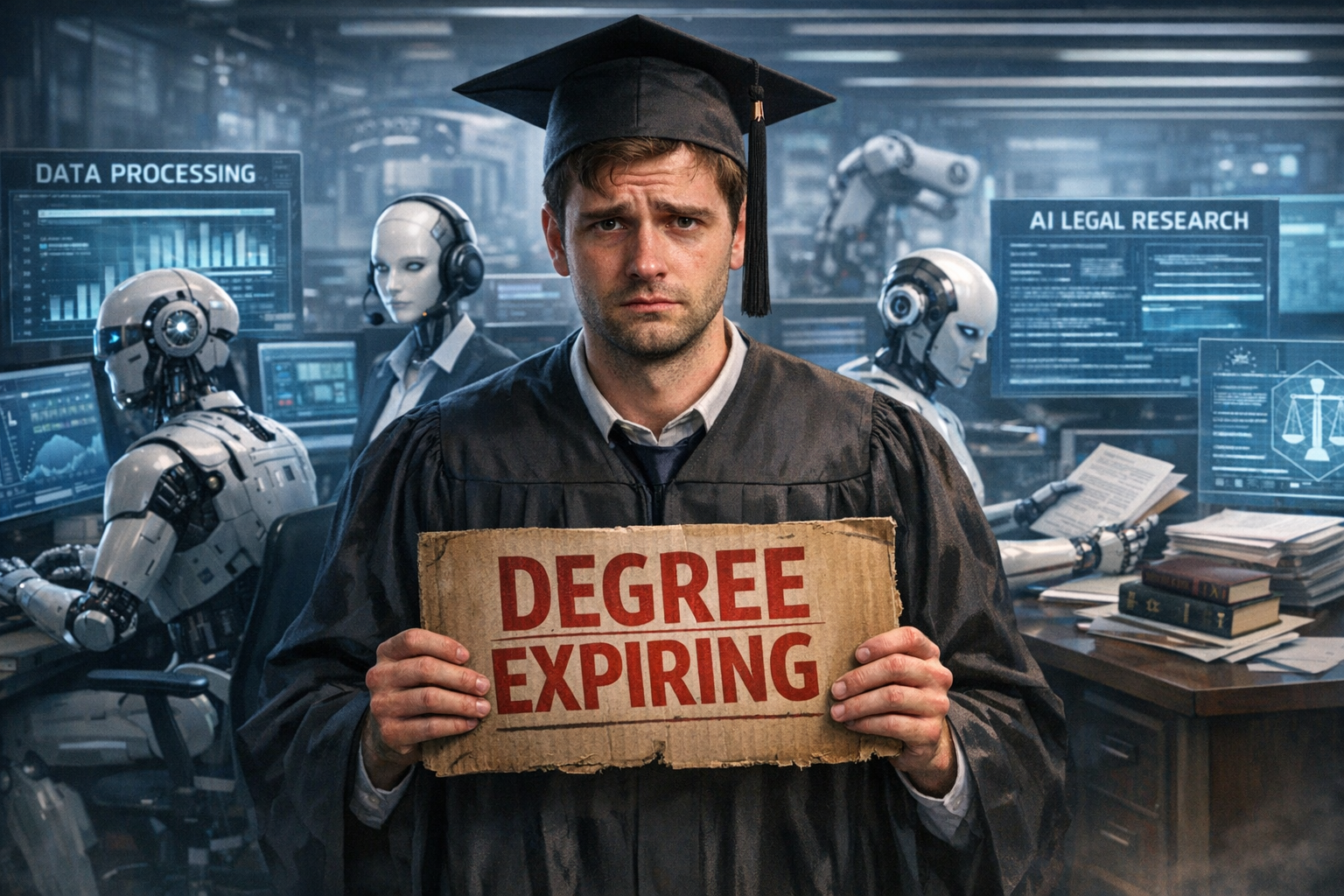
Your Parents Lied to You
"Get a degree. Get a good job. You'll be set for life."
That was the deal. Study hard, graduate, climb the corporate ladder. For decades, it worked. A college degree was a golden ticket — a guaranteed path to the middle class.
In 2026, that ticket is expiring.
The World Economic Forum estimates that 85 million jobs will be displaced by AI by the end of this year. Goldman Sachs projects 300 million full-time jobs could be replaced globally. McKinsey says 30% of current U.S. jobs could be automated by 2030, with 60% significantly altered.
This isn't a distant future. It's already happening.
The Jobs That Are Disappearing
Data Entry and Administrative Roles
Risk: 95% automation
Manual data entry clerks are the first to go. AI systems now process over 1,000 documents per hour with an error rate below 0.1%. No human can compete with that speed or accuracy. An estimated 7.5 million data entry and administrative roles could vanish by 2027.
If your job involves copying data from one spreadsheet to another — start planning your exit now.
Customer Service Representatives
Risk: 80% displacement
Of the 2.8 million customer service jobs in the United States, an estimated 2.24 million could be displaced by AI chatbots and virtual assistants. Companies like Klarna have already replaced 700 human agents with a single AI system — handling the same workload with higher customer satisfaction scores.
The remaining 20%? Complex, emotionally sensitive cases that AI still struggles with. But that window is closing fast.
Bookkeeping and Basic Accounting
Risk: 50%+ reduction by 2027
Entry-level bookkeeping roles face a 50% or greater reduction within the next year. AI tools like QuickBooks AI and Xero already automate invoicing, reconciliation, and basic tax prep. The career path from bookkeeper to accountant to CFO is being compressed — the bottom rungs of the ladder are disappearing.
Legal Support — Paralegals and Researchers
Risk: 65-80% automation
Paralegals face an 80% risk of automation by 2026. Legal researchers face 65% by 2027. AI can now review thousands of documents in hours, identify relevant case law, and draft basic legal briefs. Law firms are quietly replacing junior staff with AI tools — and charging clients the same rates.
HR and Recruitment
Risk: 85-90% automation
85% of recruitment screening and 90% of benefits administration are expected to be automated between 2025 and 2027. AI already reads resumes, ranks candidates, schedules interviews, and even conducts initial screening calls. The irony? HR departments are automating themselves out of existence.
Middle Management
Risk: 50% elimination
This is the big one. By the end of 2026, 20% of organizations will use AI to flatten their organizational structure, eliminating over 50% of current middle management positions. AI dashboards, automated reporting, and real-time analytics are replacing the people whose job was to collect information from below and report it upward.
If your job is mostly meetings, status updates, and forwarding emails — AI is coming for you.
The Emad Mostaque Warning
Emad Mostaque, the founder of Stability AI, has been one of the most vocal voices on AI's impact on work. His predictions are extreme — but increasingly hard to dismiss:
- "There will be no programmers in 5 years." AI coding tools like Claude, Cursor, and GitHub Copilot are already writing production-level code. Junior developer roles are shrinking.
- "AI agents will outperform humans on most digital tasks by 2026." Not AGI. Not superintelligence. Just competent AI workers that don't sleep, don't take vacations, and cost a fraction of a human salary.
- "Graduate jobs are disappearing." The traditional path of degree → entry-level job → career progression is breaking down because AI is eliminating the entry-level positions that used to be training grounds.
- "Resilience won't come from job titles." It will come from community, networks, relationships, and how deeply you engage with the technology itself.
Mostaque's most provocative claim: within the next 1,000 days, AI will fundamentally reshape the global economy — upending work, enterprise software, and even how we define human value.
Which Degrees Are Dying?
Based on the data from Goldman Sachs, McKinsey, and the WEF, these degree paths face the highest disruption:
High Risk
- Business Administration (general) — middle management is being automated
- Accounting (entry-level) — AI handles bookkeeping, basic audit, and tax prep
- Paralegal Studies — 80% automation risk
- Marketing (traditional) — AI generates copy, designs, campaigns, and analytics
- Computer Science (coding-only focus) — AI writes code; pure coders without system thinking are vulnerable
- Journalism — AI generates news articles, summaries, and reports at scale
- Translation / Interpretation — AI translation is approaching human quality
Medium Risk
- Law (will transform, not disappear) — junior roles automated, but strategy and courtroom work remain
- Finance — analysis automated, but client relationships and complex deals survive
- Engineering (software) — shifts from writing code to supervising AI that writes code
Lower Risk
- Medicine / Healthcare — physical, regulated, high-trust (but radiology and diagnostics face AI competition)
- Trades (electrician, plumber, HVAC) — robots can't navigate your basement yet
- Psychology / Social Work — human connection can't be automated
- Creative Arts (with AI fluency) — human taste, curation, and emotional depth still matter
- AI/ML Engineering — building the systems that replace everything else
The Goldman Sachs Paradox
Here's what's interesting: Goldman Sachs says that while 300 million jobs are at risk, only 2.5% of current U.S. employment would be immediately displaced if AI use cases were fully expanded. The rest would be transformed, not eliminated.
This is the paradox. AI doesn't make you unemployed overnight. It makes you less valuable gradually — until one day your company realizes it can do the same work with half the people.
That's more dangerous than a sudden layoff. Because you don't see it coming until it's too late.
What Actually Survives?
The WEF predicts a 40% increase in AI and machine learning specialist roles by 2027. But you don't need to become an AI engineer to survive. The jobs that endure share common traits:
- Physical presence required — plumbers, surgeons, electricians, construction workers
- High-stakes human judgment — judges, diplomats, crisis negotiators
- Deep creative vision — not generating content, but curating, directing, and making meaning
- Relationship-dependent — therapists, sales executives, community leaders
- AI orchestration — people who know how to direct AI systems to produce results
The last one is the new skill. Not coding. Not prompt engineering. AI orchestration — the ability to combine multiple AI tools, evaluate their output, and make decisions that no single model can make alone.
The Real Question
The question isn't whether your job will be affected by AI. It will.
The question is: Are you learning faster than AI is improving?
If your entire value proposition is knowledge that can be Googled, skills that can be automated, or processes that can be systematized — you're in trouble. Not because AI is smarter than you. But because AI is cheaper than you.
The new career insurance isn't a degree. It's adaptability. The ability to learn new tools faster than they replace old ones. The willingness to reinvent yourself every 3-5 years instead of every 20.
Your parents' career advice was built for a world that no longer exists. The new advice? Learn to work with the machines — or learn to do something they physically can't.
The data in this article comes from the World Economic Forum's Future of Jobs Report, Goldman Sachs Research, McKinsey Global Institute, and public statements by Emad Mostaque. For weekly insights on how AI is reshaping economics, technology, and society, subscribe to Sentinel Alpha.
Sources:
Comments
Loading comments...