
Earth After Bitcoin: The First Civilization Beyond Money Stress?
2026-03-06 · 12 min read

Bitcoin / AI
Earth After Bitcoin: The First Civilization Beyond Money Stress?
Earth After Bitcoin: The First Civilization Beyond Money Stress?

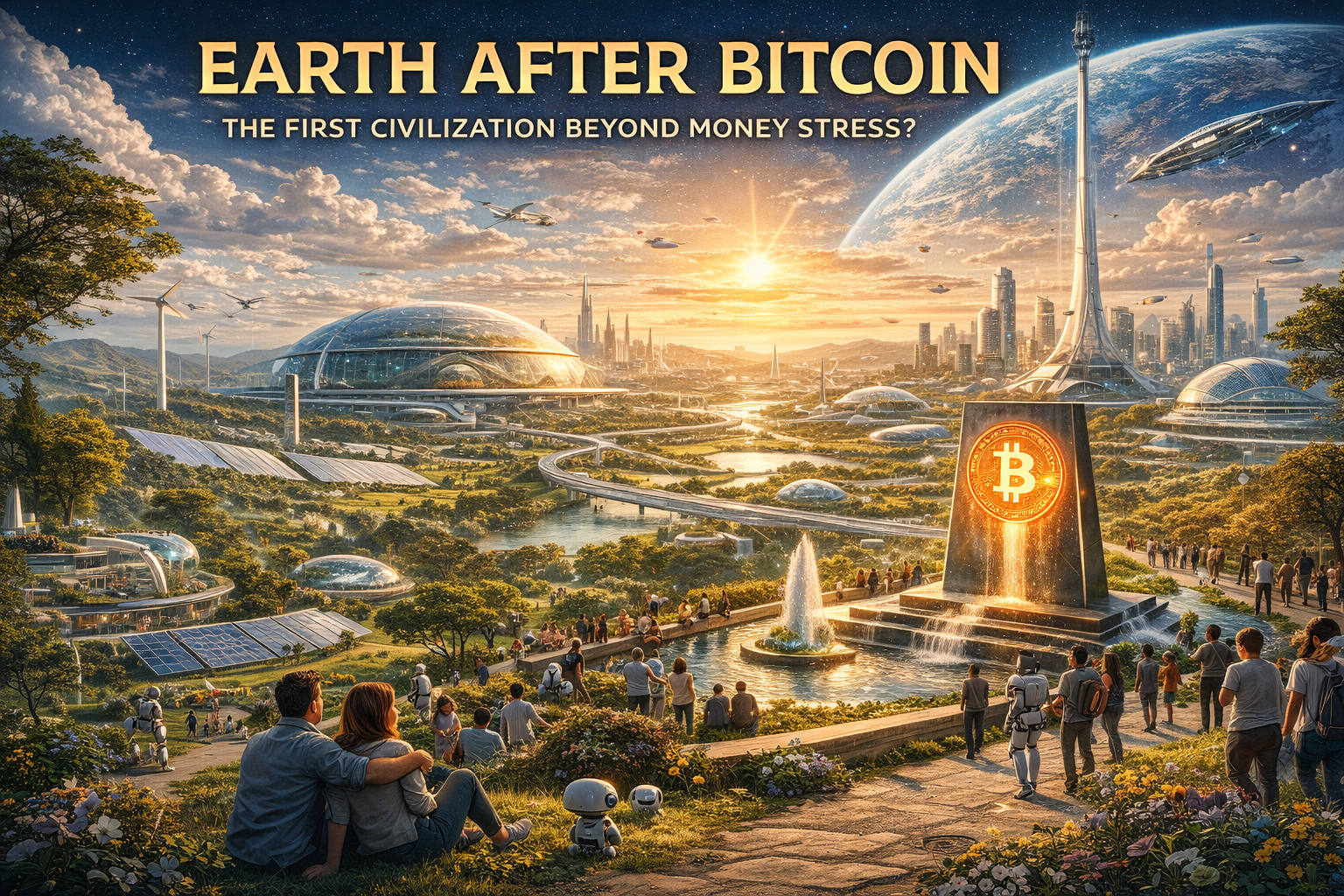
This is a scenario, not a prophecy
Call this a thought experiment grounded in real trendlines.
What would Earth look like if Bitcoin became the global reserve asset, AI took over a large share of cognitive coordination, robotics handled more of the physical workload, and energy kept getting cheaper?
Not heaven. Not magic. Not instant equality.
But possibly the first human civilization where money stops being the central source of everyday fear.
And one correction matters immediately: if Bitcoin ever reaches that role, it will likely become the world's reserve asset and settlement layer first, not the unit people use to buy coffee every morning. That distinction matters because it changes how you model the future.
Key Distinction
Bitcoin would probably become a reserve asset before it becomes everyday currency
Today's reserve system is still dominated by state-issued currencies. IMF COFER data for 2025 Q2 showed the U.S. dollar at 56.32% of allocated global FX reserves, with the euro at 21.13%.
If Bitcoin ever broke into that layer in a serious way, the deeper shift would be psychological and civilizational: governments, companies, and households would be anchoring savings to an asset that no political bloc can print, dilute, or weaponize in the traditional way.
What hard money changes
A Bitcoin-based reserve world would not eliminate human conflict, but it would change the incentive structure underneath civilization.
In a fiat system, the long-term signal is muddy. Savings are constantly measured against moving monetary targets. Debt expands faster than patience. Politics gravitates toward short-term extraction because the currency itself can be bent to absorb the stress.
Bitcoin changes that. It introduces a fixed terminal supply, a neutral settlement network, and a monetary benchmark that is not tied to a single state's military, trade balance, or electoral cycle. That does not solve every problem. But it does something foundational: it raises the cost of monetary dishonesty.
That matters because civilization is downstream from time preference. When the base layer of money becomes harder, planning horizons tend to get longer. Investment becomes less about outrunning dilution and more about building durable value.
In that world, the global economy starts to feel less like a casino with central-bank backstops and more like a coordination system built on real constraints, real productivity, and real energy.
But Bitcoin alone does not create abundance
This is the mistake many people make.
Bitcoin can create a better measuring stick. It cannot, by itself, create houses, medicine, power grids, food, transit, or care.
A harder reserve asset may reduce monetary distortion. But money stress only really falls when access to essentials becomes structurally easier.
That is why this future needs three layers working together:
- Bitcoin for monetary integrity.
- AI for cognitive coordination.
- Robotics plus cheap energy for physical abundance.
Without layers two and three, a Bitcoin world could still be brutally unequal. Hard money without abundant production is still scarcity.
Why the current system feels so strained
The stress is already measurable.
The National Endowment for Financial Education's January 27, 2026 poll on financial well-being found that U.S. adults entered 2026 under heavy financial pressure. The World Happiness Report 2025, meanwhile, focused on how caring, sharing, social trust, and eating together support human well-being. Those two realities belong in the same conversation: people are not just suffering from a lack of income. They are suffering from insecurity.
That is the important point. A better civilization is not merely one with more money. It is one where fewer people have to wake up every morning wondering whether they can still afford the basics of life.
AI lowers the cost of thought
The first half of the transition is informational.
AI is already compressing the cost of intelligence. Stanford HAI's 2025 AI Index reported that the inference cost for GPT-3.5-level performance fell more than 280-fold between November 2022 and October 2024. It also reported annual hardware-cost declines of about 30% and annual energy-efficiency gains of about 40%.
That matters more than most people realize.
When intelligence becomes cheap, society can route decisions differently:
- diagnosis gets faster
- planning gets better
- logistics get tighter
- legal and administrative overhead shrinks
- education becomes personalized
- scientific iteration accelerates
Research is already showing measurable gains. The well-known NBER and later QJE study "Generative AI at Work" found that AI assistance increased worker productivity by roughly 15% on average, with especially large gains for less experienced workers.
That suggests a future in which AI does not only replace tasks. It also spreads competence.
An abundant civilization needs exactly that. It needs systems that can distribute best practices, not just elite talent.
Robots lower the cost of execution
The second half of the transition is physical.
AI can plan. Robots can build, move, sort, inspect, weld, deliver, clean, farm, assemble, repair, and eventually construct in environments too dangerous or too remote for humans.
This is no longer hypothetical. The International Federation of Robotics reported that 542,000 industrial robots were installed in 2024, more than double the annual level of 10 years earlier. It also reported that more than 199,000 professional service robots were sold in 2024, with medical robots up 91% that year.
That is the early shape of a civilization where machines increasingly absorb the repetitive physical burden of survival.
If AI is the nervous system, robotics is the musculoskeletal system.
And once those two systems fuse, the economy changes character. Human labor stops being the only way to convert intention into reality.
Hard Truth
Abundance is not primarily a money story. It is an energy, automation, and coordination story.
Monetary reform can stop dilution. It cannot fabricate supply. If homes, electricity, transit, health care, and food remain bottlenecked, people will still feel poor even under better money.
The real breakthrough comes when the cost of both thinking and doing keeps falling at the same time.
Energy is the master variable
None of this works without power.
Energy is upstream of everything physical: manufacturing, compute, transport, desalination, fertilizer, cooling, heating, and data centers. If energy stays expensive, abundance stays local and fragile. If energy gets cheap and scalable, the ceiling rises for everyone.
Here the trend is also moving.
IRENA's 2024 report on renewable power generation costs found that in 2023 utility-scale solar PV's global weighted average cost was 56% lower than the weighted average fossil-fuel alternative, onshore wind was 67% lower, and battery storage project costs had fallen 89% since 2010.
That does not mean the energy problem is solved. Grids, storage, transmission, geopolitics, and permitting still matter enormously. But it does mean the economics of abundance are becoming less fictional.
Cheap energy plus cheap intelligence plus autonomous machines is not a niche technology trend. It is the basic architecture of a post-scarcity direction of travel.
The bridge: a Phoenix-style resource-based transition
This is where the conversation becomes more philosophical.
The fully realized world described above would not emerge in one jump. The likely bridge is a hybrid era where money still exists, markets still exist, and prices still coordinate many things - but more and more basic needs are provisioned as systems rather than purchased as constant sources of anxiety.
That is where the "Phoenix Program" and broader resource-based-economy tradition become useful as a design lens.
To be precise: I am not treating the resource-based economy as settled economic science. It is better understood as a radical systems proposal. The Venus Project describes it as a model where goods and services are increasingly distributed according to resources and technical capacity rather than money alone. That remains speculative. But the instinct behind it is important.
The instinct is this:
When coordination costs collapse, society should stop forcing every human need through maximum monetary friction.
In practical terms, the bridge may look less like "abolish money tomorrow" and more like this:
- energy, transit, education, care, and digital access become far more universal
- cities use AI to optimize resource flows in real time
- robotics expands the supply of housing, food logistics, elder care, and local manufacturing
- essential services are guaranteed more like infrastructure than luxury products
- markets continue to operate at the edges of preference, status, experimentation, and entrepreneurship
That is why Universal Basic Services may be the serious policy cousin of a resource-based economy. The Institute for Global Prosperity defines UBS as public services free at the point of need and use. That is much more grounded than a sudden moneyless world, and it fits the transition logic far better.
Bridge Model
The most realistic path is not no-money. It is less-money-pressure.
A Bitcoin reserve layer could harden savings. AI could optimize allocation. Robotics could expand supply. Universal basic services could protect dignity.
Put together, that starts to resemble a humane transition into a more resource-based civilization without requiring an overnight break from economic reality.
What everyday life on Earth might feel like
If this transition works, everyday life changes in texture before it changes in ideology.
People still create. People still compete. People still build companies, fall in love, invent things, argue about politics, and pursue status. Human nature does not vanish.
But several deep forms of pressure begin to weaken.
1. Survival becomes less monetized
Housing is designed and built faster with automated construction, modular manufacturing, and AI planning. Energy becomes cheaper at the margin. Food systems become more predictive and less wasteful. Preventive medicine becomes cheaper than late intervention.
Basic dignity stops being an extreme financial challenge.
2. Work becomes more voluntary and more creative
When AI handles coordination and robots handle much of the repetitive physical burden, humans are pushed upward into strategy, care, science, design, art, exploration, and governance.
Work does not disappear. But forced low-agency labor begins to shrink.
3. Education becomes continuous
Every person gets access to near-infinite tutoring, simulation, translation, and custom learning paths. The barrier to high-level knowledge falls dramatically. Talent is no longer wasted simply because a person was born in the wrong zip code.
4. States change role
Governments spend less energy patching preventable breakdowns and more energy stewarding shared infrastructure: data trust, energy networks, health systems, robotic logistics, and the legal boundaries around human and machine power.
5. Human ambition expands outward
Once survival is less consuming, civilization can redirect attention. Not everyone will want to leave Earth. But humanity as a whole gains spare capacity for deep science, ocean engineering, asteroid mining, lunar industry, Mars habitats, and eventually interstellar infrastructure.
In that world, humans do not explore the universe alone.
They go with AI as co-intelligence and robots as physical extension.
The most important caveat
This future does not arrive automatically just because Bitcoin wins.
A hard reserve asset can just as easily coexist with oligarchy if compute, energy, land, and robotics remain tightly concentrated. AI can be used for surveillance as easily as for liberation. Robots can serve abundance or authoritarian control. Cheap intelligence can empower citizens or automate bureaucracy against them.
The transition only works if civilization answers a moral question as well as a technical one:
When productivity explodes, who benefits?
If the answer is "only the owners of the stack," then the future becomes more efficient but not more humane.
If the answer is "everyone gets a stronger floor, and extraordinary upside still exists above it," then civilization changes course.
My base case
I do not think the end state is a perfectly moneyless world.
I think the more realistic and more beautiful future is this:
- Bitcoin becomes a neutral global reserve asset and savings benchmark
- local currencies and payment rails still exist for daily exchange
- essential services become increasingly abundant and low-friction
- AI becomes civilization's coordination layer
- robotics becomes civilization's execution layer
- humans spend less life-force on survival administration
- society shifts from scarcity management to frontier expansion
That is not the end of economics.
It is the beginning of better economics - economics after panic, after dilution, after manufactured friction, after the assumption that human beings must remain trapped in labor just to justify access to life.
And if we get that far, the next great human project will not be merely getting rich on Earth.
It will be learning how to become a multi-planetary, eventually interstellar civilization where human meaning, machine intelligence, and robotic capability move together.
That is the future worth building.
Want to stay updated? Subscribe to our newsletter or follow us on YouTube.
Sources
- Bitcoin: A Peer-to-Peer Electronic Cash System
- IMF COFER Data Brief, 2025 Q2 reserve composition
- NEFE: Financial Well-Being and Goals, January 27, 2026
- World Happiness Report 2025
- NBER: Generative AI at Work
- Stanford HAI: The 2025 AI Index Report
- IFR: World Robotics 2025 industrial robot update
- IFR: World Robotics 2024 industrial robots
- IRENA: Renewable Power Generation Costs in 2023
- Institute for Global Prosperity: Universal Basic Services
- The Venus Project: What is a Resource-Based Economy?
- Finite resources and the world economy
Comments
Loading comments...